www.ceramic-cnc-machining.com
Ceramic CNC Machining Services
Including CNC Machining, CNC Drilling, Shaping, and Polishing
Valley Design offers advanced, high-precision ceramic CNC machining services using 4- and 5-axis machines to shape hard ceramic materials like alumina, aluminum nitride, and Macor into complex components with micron-level accuracy, providing various surface finishes and applications in industries such as aerospace, medical, and electronics.
Ceramic Computer Numerical Control (CNC) machining is a manufacturing method where computer-controlled machines shape ceramic materials into various forms. This process uses techniques such as milling, drilling, grinding, and turning, often employing diamond-coated or solid diamond tools to ensure precise cuts and detailed designs. It is especially effective for hard, brittle ceramics. The pre-programmed computer software that controls the movement of the cutting tools ensures high precision, enabling the creation of complex geometries.
Ceramic materials are valued for their hardness, heat resistance, and chemical stability, making them ideal for demanding applications in industries such as aerospace, medical, and electronics. However, these unique properties create specific challenges. Machining ceramics requires specialized techniques and tools to prevent cracking and chipping.
Valley Design provides high-precision ceramic CNC machining services, focusing on on-demand 4- and 5-axis CNC machining of all hard materials. Valley Design CNC machines ceramic materials such as Aluminum Nitride, 96% Alumina, 99.6% Alumina, and Macor from our extensive inventory or can modify customer-supplied ceramic materials. From custom prototyping and research & development to full production manufacturing, Valley Design’s expertise in ceramic CNC machining is unmatched.
Founded in 1975, Valley Design sets the global standard for excellence, quality, and precision, leading the industry in advanced materials processing. Ceramic materials of all types and hardness can be machined to the highest accuracy and repeatability with extremely tight tolerances. Achievable surface finishes, roughness, flatness, and other specifications are supported by advanced 4–5 axis CNC machining and grinding equipment. Precision CMM and 3D surface profile metrology ensure exceptional quality and product performance.
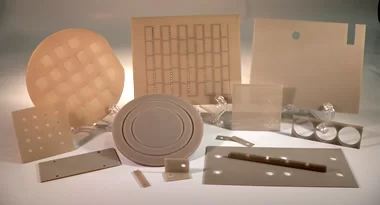
Ceramic Materials CNC Machined:
- 96%, 99.5%, and 99.6% Alumina (Al203)
- Aluminum Nitride (AlN)
- Black Ceramic
- Crystals Exotic
- Ferrites
- Glass Ceramics
- Macor
- Porous Ceramics
- Silicon Carbide (SiC)
- Silicon Nitride (SiN)
- Steatite
- Technical Ceramics
- ULE Glass Ceramic
- Many other hard materials
Complex Features and Advanced CNC Machining Capabilities:
Using 3+2 simultaneous 5-axis CNC precision machining, complex components and assemblies can be produced. Features are created with through-spindle cooling, vacuum hold-down, and advanced, non-contact laser-based tool settings.
Complex features include:
- Channels
- Domed profiles
- Grooves
- Pockets
- Radii
- Slits
- Slots
- Steps
- Textures
- Thru-holes
- Trenches
Advanced capabilities include:
- Accuracy to micron levels ± .5um (microns)
- Ceramic surface roughness ranging from
- Concave / Convex surface profiles
- Size ranges from as small as .127mm (.005” sq.) to over 450mm (17.75” diameter)
- Ultra flat to 1/10 wave
- Ultra-thin thickness of 10- 15 μm thick
- 32u”Ra – 64u”Ra – CNC Machined Finish
- 25u” Ra – CNC Fine Machined Finish
- 10-20u”Ra – Standard Lapped Finish
- 4 – 8u”Ra – Diamond Lapped Finish
- 2-4u”Ra – Slightly Reflective Finish
- .5-1u”Ra – Highly Reflective Finish
These various surface finishes are achievable by combining CNC machining capabilities with Valley Design’s comprehensive lapping and polishing expertise.
CNC Ceramic components include:
- Dielectrics and Insulators
- Rings
- Shims
- Spacers
- Submounts
- Substrates
- Substrates for ESC Electrostatic Chucks
- Vacuum Chucks
- Wafer Chucks
- Wafers
- Washers
Advantages of CNC Machining of ceramics
There are many advantages to using hard materials like Aluminum Nitride (AIN), Alumina (A1203) Ceramic Sapphire, and Silicon Carbide (SiC) instead of common metals such as aluminum, steel, and other alloys.
By choosing to create custom complex components with a 5-axis CNC machine, you benefit from materials that are harder and more resistant to compression than most metals. They can also be electrically or thermally insulative or conductive.
The ability to withstand harsh and corrosive environments and extreme temperatures is just some of the many applications. Replacing metals with Aluminum Nitride (AN), ceramics (like Alumina, Sapphire, SIC), and other hard materials can make the difference between a good product and a superior, long-lasting one.
Alumina ceramics (Aluminum Oxide, Al₂O₃) are the most commonly used technical ceramics due to their versatile properties and performance. They are usually categorized by their purity level, typically ranging from 96% to 99.8%. High-purity alumina enhances wear and corrosion resistance in both general and specialized uses, especially where electrical insulation, dielectric strength, and low dielectric loss are critical.
Alumina ceramics, Al₂O₃, possess well-balanced properties of insulation, thermal conductivity, and breaking strength. A key feature is surface roughness. Its very fine particles enable excellent adhesion with both thin and thick film metallization. Its smoothness, flatness, low porosity, minimal warpage, bending, and undulation make it an ideal choice for many semiconductor chuck applications. Valley Design has been CNC machining and refurbishing alumina chucks of all types, including electrostatic chucks, in high volumes for over 50 years.
Advantages of CNC Machining of Macor Ceramics:
Macor, produced by Corning, is a material that combines the properties of glass and ceramic, offering machinability, high-temperature stability, electrical insulation, and radiation resistance.
Macor’s machinability properties originate from its unique microstructure, which includes Mica Crystals dispersed within an Alumina Borosilicate matrix. CNC machining of Macor is more forgiving than that of most other ceramics, reducing issues such as cracks and chipping during continuous use at 800 degrees C. The Coefficient of Expansion (CTE) of Macor is comparable to that of most metals and sealing glasses. It is non-wetting, has zero porosity, and remains highly dimensionally stable. Macor is an excellent insulator, especially in high-temperature environments, high voltages, and across various frequencies. Typical applications include ultra-high vacuum environments, aerospace, electrical insulators, semiconductor thermal chucks, and IC test sockets.
Ready to Elevate Your Business?
At Valley Design, we combine innovation, precision, and reliability to provide top-quality manufacturing solutions tailored to your needs. Whether you’re focused on efficiency, speed, or scalability, we’re here to help. Contact us online or call us at 978-425-3030 today for a consultation, and let’s create something extraordinary together!